
A party wall notice must contain the building owner's name and address, the adjoining owner's name and address, a description of the proposed works, the date the works are intended to start, and the section of the Party Wall etc. Act 1996 being relied upon. Section 1 and Section 6 notices require 1 month notice. Section 2 notices require 2 months. Use the official GOV.UK example letters and the practical guidance below.
Last updated: 20 May 2026
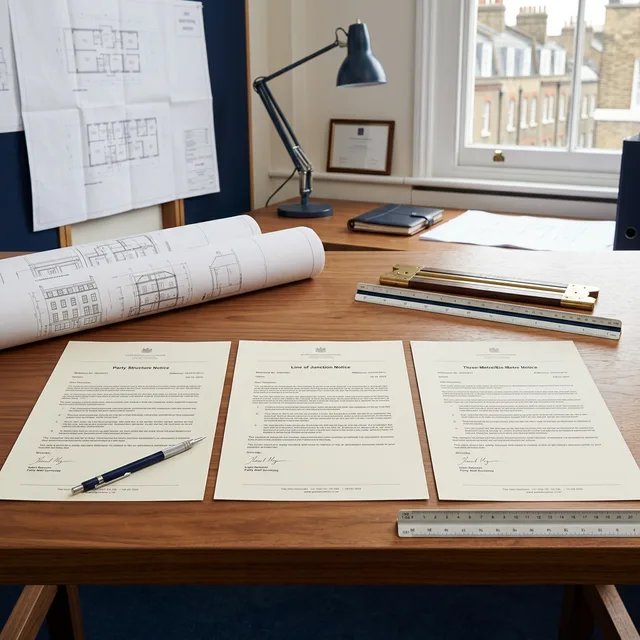
Table of contents
- Official example letters and required information
- What every party wall notice must contain
- Section 1, 2, and 6: which template applies
- How to serve the notice correctly
- 7 common mistakes that invalidate the notice
- What happens after you serve the notice
Official example letters and required information
GOV.UK publishes example letters for party structure, line of junction and adjacent excavation notices. Check the correct notice type, service method, property details, work description and required drawings. The statutory content varies by notice type, and special service provisions can apply when an owner's name is unknown.
| Template | Section | Notice period | Most common use |
|---|---|---|---|
| Line of Junction Notice | Section 1 | 1 month | Building a new wall at the line of junction |
| Party Structure Notice | Section 2 | 2 months | Cutting into, raising, or removing a party wall or other party structure |
| Notice of Adjacent Excavation | Section 6 | 1 month | Excavating within 3m or 6m of adjoining building |
For party structure and excavation notices, absence of written consent within 14 days triggers the dispute procedure. Section 1 new-wall notices have different consequences. Where a dispute arises, owners appoint an agreed surveyor or separate surveyors; section 10(4) addresses refusal to appoint and neglect for ten days after a written request. The notice period is the minimum time between serving the notice and starting the works. It is not the same as the 14 days the adjoining owner has to respond.
Download the official GOV.UK example letters. If you are unsure which notice applies, ask a party wall surveyor to review the proposed works before service.
What every party wall notice must contain
A party wall notice should contain the seven elements below. Leaving out required information can make the notice invalid, in which case a fresh notice must be served and the notice period starts again.
- Full name and address of the building owner: if there are multiple owners, all names must appear. Limited companies should include their registered office address.
- Full name and address of the adjoining owner: not just the property address. If you are unsure who owns the neighbouring property, a Land Registry title search will confirm it.
- Address of the property where works will take place: full address including postcode.
- A clear description of the proposed works: the description must be specific enough that the adjoining owner can understand what is happening. Drawings help, and for Section 6 excavation notices, plans and sections are required.
- The intended start date: must be at least 1 month (Sections 1 and 6) or 2 months (Section 2) after the notice service date.
- The section of the Act being relied upon: Section 1, 2, or 6, with sub-section specified where applicable.
- Date and signature: signed and dated by the building owner or their authorised agent.
Section 1, 2, and 6: which template applies
Section 1: Line of Junction Notice
Section 1 applies when you are building a new wall at the line of junction between two properties, whether astride the line or wholly on your own land with the wall built up against it. The most common Section 1 scenario is building a new party fence wall or boundary wall, or building a new structure with foundations at or crossing the line of junction.
Section 2: Party Structure Notice
Section 2 applies to any works affecting an existing party wall or party structure. This includes cutting into the wall, raising the wall, demolishing and rebuilding, underpinning, removing a chimney breast or chimney stack on a party wall, and inserting damp proof courses. Floors and ceilings between flats are party structures too, so works to them also need a Section 2 notice. The 2-month notice period is the longest under the Act.
Section 6: Notice of Adjacent Excavation
Within 3 metres, section 6 depends on excavation below the neighbouring foundations. Within 6 metres, it depends on whether the work meets the statutory plane drawn down at 45 degrees from the neighbouring foundations towards the excavation. A section 6 notice must include plans and sections showing the site and depth.
How to serve the notice correctly
Service of the notice is as important as the content. Incorrect service can invalidate the notice even if every other detail is right. The common methods of service are set out below.
- By hand: deliver to the adjoining owner in person, with a witness present to confirm date and time of delivery. Keep a signed record.
- By post: addressed to the adjoining owner at their usual or last-known residence or place of business. Recorded delivery gives you evidence of delivery.
- Affixed to a conspicuous part of the property: only in limited circumstances, for example where the notice is addressed to "the owner" of the premises and no one can be found there to receive it. This is rare and should be avoided unless absolutely necessary.
Keep clear evidence of when the notice was received, because the response period and the notice period both run from service.
7 common mistakes that invalidate the notice
- Failing to name all owners. If a property is jointly owned, all owners should be named and served.
- Vague works description. "Loft conversion" alone is insufficient. The description should include specific works: "insertion of steel beams to the party wall to support new attic floor, removal of existing roof structure, construction of new rear dormer."
- Wrong notice period. Giving 1 month when Section 2 requires 2 months invalidates the notice. The notice period is fixed by the Act.
- Using electronic service without agreement. Electronic service should only be used where the recipient has agreed to receive notices that way. Keep evidence of that agreement and delivery.
- Missing the start date. The notice must state when works are intended to begin. "As soon as possible" is not sufficient.
- Citing the wrong Section. A notice citing Section 2 for works that should be Section 6 is invalid. Use the correct Section template.
- Serving the occupier only. Notices must be served on every owner. Under the Act, leaseholders with a lease of more than a year are owners as well as the freeholder, so both may need to be served.
What happens after you serve the notice
For party structure and excavation notices, absence of written consent within 14 days triggers the dispute procedure. Section 1 new-wall notices have different consequences. Where a dispute arises, owners appoint an agreed surveyor or separate surveyors; section 10(4) addresses refusal to appoint and neglect for ten days after a written request. Once the notice is served, the adjoining owner has 14 days to respond. There are three possible responses, each of which triggers a different next step.
Consent. The adjoining owner returns a written consent. No award is needed. Works can proceed after the notice period expires. Keep the consent with your property records.
Dissent. The adjoining owner appoints their own surveyor or agrees to an agreed surveyor acting for both owners. The Section 10 dispute procedure begins. An award is drafted and served before the notifiable works commence.
Silence. If the adjoining owner does not consent within 14 days, a dispute is deemed to have arisen (Section 5, or Section 6(7) for excavation notices). If they then do not appoint a surveyor, you must serve a further written request asking them to appoint one within 10 days. Only if that request is ignored can you appoint a surveyor on their behalf under Section 10(4).
For more detail on the response window, see our party wall notice guide.
Service of notice: the methods explained in detail
Section 15 of the Party Wall etc. Act 1996 sets out service requirements. Electronic service can be used where the recipient has agreed to receive documents that way; otherwise use an appropriate statutory service method and retain evidence. Service is one of the most commonly missed compliance points.
Method 1: Personal delivery by hand
The notice is handed to the adjoining owner in person. Ideally a witness is present to confirm the date and time of delivery and signs a brief note confirming it. Keep this note with the copy notice in your records.
This method is quick but requires the adjoining owner to be available. If they refuse to take the notice, the witness note records that it was tendered.
Method 2: Post
The notice is sent by post to the adjoining owner's usual or last-known residence or place of business. Using a tracked or signed-for service gives you evidence of the delivery date.
This is the most commonly used method because it provides clear evidence without requiring direct interaction with the adjoining owner. Allow time for delivery before counting the response period and notice period.
Method 3: Affixing to the property
In limited circumstances, such as where the notice is addressed to "the owner" of the premises and nobody is found there to receive it, the notice can be affixed to a conspicuous part of the property. This method is rare and risky. Document the enquiries you made to identify and reach the owner, such as Land Registry searches, before relying on it.
The 14-day response window: what to expect day by day
For party structure and excavation notices, absence of written consent within 14 days triggers the dispute procedure. Section 1 new-wall notices have different consequences. Where a dispute arises, owners appoint an agreed surveyor or separate surveyors; section 10(4) addresses refusal to appoint and neglect for ten days after a written request.
| Day | What typically happens |
|---|---|
| Day 0 | Notice received by adjoining owner. |
| Day 1 to 3 | Adjoining owner reads the notice. May contact you or your surveyor with initial questions about the works scope. |
| Day 4 to 7 | Adjoining owner seeks professional advice. Many will consult a party wall surveyor at this stage for an initial review of the notice. |
| Day 8 to 11 | Adjoining owner decides whether to consent or dissent. May ask for additional information about the works. |
| Day 12 to 14 | Response served (or not). If consenting, written consent is returned. If dissenting, surveyor appointment letter is sent. If no consent is given, a dispute is deemed to have arisen once the 14 days have passed. |
| After day 14 | If no surveyor has been appointed, the building owner serves a written request to appoint a surveyor within 10 days under Section 10(4). If that is ignored, the building owner can appoint a surveyor on the adjoining owner's behalf. |
Multiple adjoining owners: how to serve correctly
Many residential properties have more than one adjoining owner. A mid-terrace house has two adjoining owners (one each side). A corner property may have several adjoining owners with different boundaries. A leasehold property can have both the leaseholder and the freeholder as adjoining owners.
The Party Wall Act requires notice to be served on every adjoining owner whose property is affected by the works. Missing an owner means the works are not authorised against that owner and exposes the building owner to an injunction.
Three multi-owner scenarios require careful handling:
- Mid-terrace properties with two neighbours. Serve notice on both. Each may consent, appoint their own surveyor, or agree to an agreed surveyor. Each dissenting neighbour normally needs their own schedule of condition and award.
- Leasehold property with both leaseholder and freeholder. Serve notice on both the leaseholder and the freeholder. The freeholder may appoint a surveyor even if the leaseholder consents, particularly for structural works.
- Properties with several owners. Serve notice on each owner. Land Registry will confirm legal ownership.
Because each adjoining owner is a separate party under the Act, our building owner fees are charged per adjoining owner: Party Wall Notice £100*, Schedule of Condition £500*, Party Wall Award £800*.
*Fees shown are for typical homeowner projects. More complex matters, for example those involving a checking engineer, section 10(4) notices and appointments, section 11 enclosure costs or security for expenses, and larger buildings in single ownership, carry additional charges. These are confirmed before work starts.
Notice content best practice beyond the legal minimum
The seven elements listed earlier are the minimum. Notices that include only the minimum are valid but can produce worse outcomes than notices that include some helpful additional content. Three additions tend to improve adjoining owner responses and reduce disputes.
The first addition is a clear and accessible description of the works in non-technical language. Legal descriptions referencing structural drawings and engineering specifications are technically valid but often hard for a layperson to evaluate. A plain description (for example "we are converting our loft into two bedrooms with a small rear dormer; this requires inserting two steel beams into the party wall to support the new attic floor") makes the works understandable to the adjoining owner, which makes an informed consent more likely.
The second addition is an outline programme showing when works are expected to start and finish, and the working hours you intend. Adjoining owners are often more concerned about disruption than structural details. If a dispute arises, the working hours are set by the surveyors in the award, but sharing your intentions early answers the most common questions.
The third addition is a friendly cover letter explaining the legal context, the building owner's intentions, and contact details for questions. Many adjoining owners receive party wall notices with confusion or alarm, particularly if this is their first experience of the Act. A cover letter that explains the situation in plain language and invites questions makes the process feel collaborative rather than adversarial.
Handling a counter-notice from the adjoining owner
Section 4 of the Party Wall etc. Act 1996 allows an adjoining owner who receives a party structure notice to serve a counter-notice within one month. A counter-notice can require the building owner to build in additional works for the adjoining owner's convenience, such as chimney copings, breasts, jambs or flues, or piers or recesses, or to place special foundations deeper or make them stronger.
The building owner must comply with a valid counter-notice unless the requested works would be injurious to the building owner or cause unnecessary inconvenience or delay. Where works are carried out at the adjoining owner's request for their own benefit, the adjoining owner generally pays for them. Any dispute about the requested works or who pays is determined by the surveyors under Section 10.
If you receive a counter-notice as the building owner, do not respond immediately. Ask your surveyor to review it. The surveyors will determine whether each request falls within the Act and is reasonable, and who should bear the cost, impartially and in line with the Act.
Record keeping after notice service
After serving the party wall notice, retain a complete record of the service evidence. The record should include: a copy of the served notice, postal tracking confirmation or witness note (for hand delivery), the adjoining owner's response (if any), and any subsequent correspondence. These records protect the building owner if the validity of service is questioned later, particularly during property sale checks.
Building owners should also keep a digital backup of all notice service evidence in a dedicated project folder, organised by date and adjoining owner. This organised record is invaluable when the property is sold years later and the buyer requests evidence of party wall compliance for works carried out during ownership.
The bottom line
A valid party wall notice contains the required information, cites the correct section (1, 2, or 6), gives the correct notice period (1 month for Sections 1 and 6, 2 months for Section 2), and is served using a method permitted by the Act. Electronic service can be used where the recipient has agreed to receive documents that way. The official example letters cover the main notice types. If the works are complex or you are unsure which section applies, a party wall surveyor can draft and serve the notice for you.
Need the notice drafted and served correctly? Our building owner fee for a Party Wall Notice is £100* per adjoining owner. Contact London Party Wall Surveyors at londonpws.co.uk/appoint-londonpws-surveyor/ or call 020 7050 0715, and you will be kept updated at every stage from notice to the final award.
Sources
- Party Wall etc. Act 1996, full text, legislation.gov.uk
- UK Government explanatory booklet on the Party Wall Act
Published fees apply to typical homeowner projects, per adjoining owner. Complex work carries additional charges; Land Registry searches and postage may apply. Additional Awards on the same project are charged at 50% of the standard fee. Scope and fees are confirmed before instruction.