For party structure and excavation notices, absence of written consent within 14 days triggers the dispute procedure. Section 1 new-wall notices have different consequences. Where a dispute arises, owners appoint an agreed surveyor or separate surveyors; section 10(4) addresses refusal to appoint and neglect for ten days after a written request.
Last updated: 20 May 2026
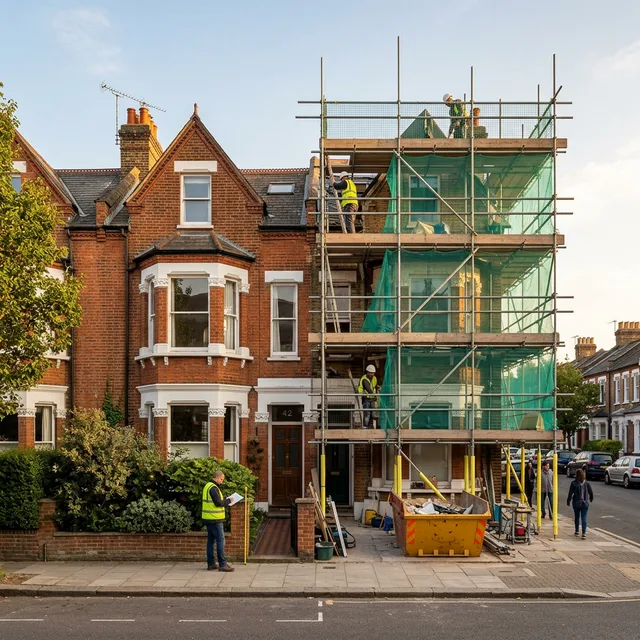
Table of contents
- How a party wall dispute arises
- Typical situation 1: a counter-notice on a loft conversion
- Typical situation 2: surveyors disagree on a basement award
- Typical situation 3: cracks reported after completion
- Typical situation 4: scaffold and access on a rear extension
- Typical situation 5: a dispute over surveyor fees
- Appealing an award
- Practical lessons
The situations below are general illustrations of common dispute types. They are not accounts of particular clients, properties or outcomes.
How a party wall dispute arises
Under the Act, "dispute" has a technical meaning. If an adjoining owner does not give written consent within 14 days of receiving a party structure notice, a dispute is deemed to have arisen (Section 5). The same applies to excavation notices under Section 6(7). It does not mean the neighbours have fallen out. It simply means the matter is resolved by surveyors under Section 10.
Each owner can appoint their own surveyor, or both can agree on a single agreed surveyor. If the adjoining owner fails to appoint, the building owner must first serve a further written request asking them to appoint a surveyor within 10 days. Only if that request is ignored can the building owner appoint a surveyor on the adjoining owner's behalf (Section 10(4)). Your neighbour can only appoint a surveyor for you in that way, if you fail to appoint within 10 days of a formal request.
Party-appointed surveyors do not act as advocates. They must act impartially and determine matters in line with the Act. In practice, you choose the surveyor who inspects your property and agrees the award with your neighbour's surveyor. Where the two surveyors cannot agree, either surveyor or either owner can refer the matter to the third surveyor the two surveyors selected at the outset (Section 10(11)).
Typical situation 1: a counter-notice on a loft conversion
The setting: a building owner in a terraced or semi-detached house plans a loft conversion with steel beams bearing on the party wall, and serves a Section 2 notice at least two months before the works.
What can happen: the adjoining owner may serve a counter-notice under Section 4 within one month of receiving the notice. A counter-notice can require additional works for the adjoining owner's convenience, such as chimney copings, breasts, jambs or flues, or piers or recesses, or ask for special foundations to be placed deeper or made stronger.
How the Act deals with it: the building owner must comply unless the requested works would be injurious to them or cause unnecessary inconvenience or delay. Works carried out at the adjoining owner's request for their own benefit are generally paid for by the adjoining owner. The surveyors include the agreed works and the cost position in the award.
Key takeaway: a counter-notice is a legitimate right under the Act, not an act of hostility. It can add time to the process, so allow for it in your programme.
Typical situation 2: surveyors disagree on a basement award
The setting: a building owner plans a basement and serves a Section 6 notice with plans and sections showing the depth of the excavation. Each owner appoints a surveyor and the schedule of condition is completed without difficulty.
What can happen: the surveyors may disagree on particular provisions, for example the level of movement or vibration monitoring during excavation, or a request by the adjoining owner for security for expenses (Section 12) before the works start.
How the Act deals with it: most disagreements are resolved by the two surveyors discussing the engineering information and reaching a view. Where they genuinely cannot agree, either surveyor or either owner can call on the third surveyor to determine the disputed points and make the necessary award (Section 10(11)). The third surveyor decides who pays the costs of that referral.
Key takeaway: the third surveyor exists to break genuine deadlocks without going to court. A referral adds time, so it is worth both surveyors working through the technical evidence first.
Typical situation 3: cracks reported after completion
The setting: a building owner completes a rear extension that involved cutting into the party wall. Some weeks later, the adjoining owner notices new cracks on their side of the wall.
What can happen: the adjoining owner reports the cracks and the surveyors arrange an inspection. The question is whether the cracks are new and whether the works caused them.
How the Act deals with it: the surveyors compare the property with the schedule of condition taken before the works. If they determine that the works caused damage, the building owner must compensate the adjoining owner (Section 7(2)). This is usually done by making good, but the adjoining owner can ask for payment in lieu of making good, determined by the surveyors (Section 11(8)).
Key takeaway: the schedule of condition is what turns a potential argument about pre-existing cracks into a straightforward comparison. See our guide to schedules of condition before neighbouring excavation.
Typical situation 4: scaffold and access on a rear extension
The setting: a building owner building a rear extension at the line of junction needs scaffold access from the neighbour's garden for part of the works.
What can happen: the adjoining owner accepts that access is needed but is concerned about where the scaffold stands, for example on new paving or planting, and about how long it will be there.
How the Act deals with it: Section 8 gives the building owner, their workmen and surveyors rights of entry for the purpose of carrying out works under the Act. Those rights are not unlimited. The surveyors can set conditions in the award covering how access is taken, how the neighbour's property is protected and how it is reinstated. Working hours are also set by the surveyors in the award, rather than being something either owner has a right to agree.
Key takeaway: access questions are common and usually resolved through the award. Raise them early so the surveyors can deal with them before works begin.
Typical situation 5: a dispute over surveyor fees
The setting: once the award is served, the building owner receives the adjoining owner's surveyor's account and considers it too high for the work involved.
What can happen: the building owner normally pays the reasonable costs of making the award and the surveyors' reasonable fees, but only reasonable fees. A building owner who disputes the amount can ask for a breakdown of the work done.
How the Act deals with it: what is reasonable is not set by the value of the property; it depends on the work reasonably required. A fee disagreement can be referred to the third surveyor, or an award dealing with fees can be appealed to the county court within 14 days of service. Surveyors' fees awarded are recoverable as a civil debt under Section 17.
As adjoining owner's surveyor, our reasonable fees are normally paid by the building owner under the Act.
Key takeaway: ask any surveyor at the outset how they will keep you updated and what their fees cover, and raise concerns early rather than after the award is served.
Typical situation 6: several notices on one project
Some projects need more than one notice, for example a loft conversion (Section 2), a new boundary wall (Section 1) and an excavation (Section 6) on the same site. Each notice has its own notice period: two months for Section 2 and one month for Sections 1 and 6. These projects naturally involve more provisions in the award and more scope for disagreement, so allow extra time, provide full drawings and engineering details early, and expect the surveyors to deal with each element in turn.
Appealing an award
Either owner can appeal an award to the county court within 14 days of it being served. An appeal can challenge the substance of the award, not only procedural errors. Before starting the relevant works, check that the statutory notice period has expired or an earlier start has been agreed, and comply with the award and other required permissions. An appeal does not automatically stop the works.
Appeals are uncommon because most matters are resolved between the surveyors, but it is important to take advice promptly if you are unhappy with an award, because the 14-day window is short.
Practical lessons
Five practical points apply to most West London party wall situations, whether you are the building owner or the adjoining owner.
First, talk before serving the notice. A short conversation with the neighbour explaining the planned works, the programme and how you will serve the formal notice makes the process feel collaborative rather than adversarial.
Second, have the photographic schedule of condition done early and treat it as protection for both households. It is the document that matters most if damage is reported later.
Third, choose a surveyor on experience, not on headline price or membership letters. Ask how many awards they have prepared for similar works, whether they carry professional indemnity insurance, and how they will keep you updated.
Fourth, understand the timeline. From notice to award typically takes 6 to 8 weeks, and counter-notices, non-appointment and third surveyor referrals can extend that. Build it into your programme.
Fifth, keep records throughout the works. Dated photographs and notes of any incidents are useful alongside the formal schedule of condition if questions arise later.
The bottom line
Most party wall disputes are resolved by the surveyors under Section 10 without going to court. Counter-notices, technical disagreements, damage after completion, access questions and fee disagreements each have a clear route under the Act: an agreed award, the third surveyor, or, rarely, an appeal to the county court within 14 days. A good schedule of condition and early, open communication between neighbours resolve more problems than anything else.
Facing a party wall dispute? Speak to London Party Wall Surveyors at londonpws.co.uk/appoint-londonpws-surveyor/ or call 020 7050 0715. Free initial consultation, and you are kept updated at every stage from notice to the final award.
Sources
- Party Wall etc. Act 1996, Section 10, legislation.gov.uk
- Party Wall etc. Act 1996, Section 11, legislation.gov.uk
- UK Government explanatory booklet on the Party Wall Act
Published fees apply to typical homeowner projects, per adjoining owner. Complex work carries additional charges; Land Registry searches and postage may apply. Additional Awards on the same project are charged at 50% of the standard fee. Scope and fees are confirmed before instruction.