If your neighbour in Hillingdon or elsewhere in West London plans a basement, underpinning or other excavation near your home, a photographic schedule of condition taken before the works start is your best protection. It records the condition of your property, agreed by the surveyors, so that any new cracking can be told apart from defects that were already there. The building owner carrying out the works normally pays for it as part of the party wall process.
Last updated: 20 May 2026
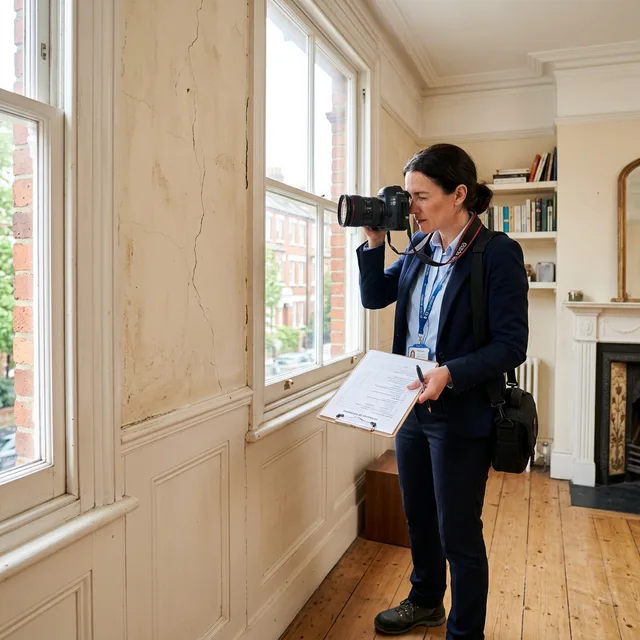
Table of contents
- A typical situation: a neighbour's basement next to a semi-detached house
- Why a schedule of condition works
- Who pays for the schedule
- How the process usually runs, from notice to final inspection
- Practical points for West London homeowners
A typical situation: a neighbour's basement next to a semi-detached house
The situation below is a general illustration of how these matters commonly unfold. It is not an account of any particular client or property.
Picture a semi-detached Edwardian or 1930s house of the kind found across Hillingdon, Uxbridge, Ruislip and Hayes. The neighbour plans to excavate a basement under their kitchen, deeper than the foundations of the house next door and within 3 metres of it. Because of the distance and depth, the neighbour must serve a Section 6 notice of adjacent excavation at least one month before starting, with plans and sections showing the site and depth of the excavation.
For party structure and excavation notices, absence of written consent within 14 days triggers the dispute procedure. Section 1 new-wall notices have different consequences. Where a dispute arises, owners appoint an agreed surveyor or separate surveyors; section 10(4) addresses refusal to appoint and neglect for ten days after a written request.
Houses of this age often already have some hairline cracking, particularly at window corners and ceiling junctions. If new cracking appears during or after the excavation, the question everyone asks is: was this crack there before? Without a record, that becomes an argument. With a good schedule, the surveyors can compare the property against an agreed baseline.
Why a schedule of condition works
A well-prepared photographic schedule records the condition of the rooms, walls and external elevations most likely to be affected by the works. It includes dated photographs, a written description of each visible defect, and a simple layout plan so each defect can be located again later.
When the works are complete, the surveyors revisit and compare the property against the schedule. A crack that is clearly visible in the original photographs is pre-existing. A crack that does not appear in them, in a location the schedule covered, points towards the works.
| Schedule of condition element | Why it matters if damage is reported |
|---|---|
| Dated photographs of each affected area | Allows a like-for-like comparison before and after the works |
| Written description of every visible defect | Records what was already there, so it cannot later be blamed on the works |
| Layout plan with numbered defects | Makes it quick to locate any reported damage against the record |
| Agreed by both surveyors and attached to the award | Gives both owners a shared starting point that is hard to dispute later |
Who pays for the schedule
The building owner carrying out the works normally pays the surveyors' reasonable fees and the costs of making the award, and the schedule of condition is part of that process. In most cases the adjoining owner pays nothing for it. As building owner's surveyor, our fee for a Schedule of Condition is £500* per adjoining owner.
*Fees shown are for typical homeowner projects. More complex matters, for example those involving a checking engineer, section 10(4) notices and appointments, section 11 enclosure costs or security for expenses, and larger buildings in single ownership, carry additional charges. These are confirmed before work starts.
As adjoining owner's surveyor, our reasonable fees are normally paid by the building owner under the Act.
If works cause damage, the building owner must compensate the adjoining owner for loss or damage resulting from the works (Section 7(2)). The usual approach is for the building owner to make good the damage, but the adjoining owner can instead ask for payment in lieu of making good, with the amount determined by the surveyors (Section 11(8)).
For more on schedule of condition pricing, see our schedule of condition cost guide. For the broader question of when a schedule is needed, see our schedule of condition service page.
How the process usually runs, from notice to final inspection
- Notice served: a Section 6 notice at least one month before the excavation starts (or a Section 2 notice at least two months before works to the party wall itself).
- For party structure and excavation notices, absence of written consent within 14 days triggers the dispute procedure. Section 1 new-wall notices have different consequences. Where a dispute arises, owners appoint an agreed surveyor or separate surveyors; section 10(4) addresses refusal to appoint and neglect for ten days after a written request.
- Surveyors appointed: each owner appoints a surveyor, or both agree on one agreed surveyor. If the adjoining owner does not appoint, the building owner must serve a further written request to appoint within 10 days before appointing on their behalf (Section 10(4)).
- Schedule of condition: the adjoining property is inspected and recorded before any works start.
- Award served: the surveyors agree and serve the award setting out how the works can proceed. The whole process from notice to award typically takes 6 to 8 weeks.
- Works: the building owner's contractor carries out the works in line with the award.
- Final inspection: after completion, the surveyors check the adjoining property against the schedule and deal with any damage under the Act.
Practical points for West London homeowners
The schedule of condition is one of the most undervalued documents in the party wall process. Some adjoining owners decline it because they assume it only benefits the building owner. In practice, it protects both owners.
Three points apply to most West London party wall situations involving excavation, basement works, or significant structural alteration:
- Ask for a photographic schedule, not a written-only one. Written descriptions are open to interpretation. Photographs are much harder to argue with.
- Make sure the schedule is completed before any works commence. A schedule taken after works have started has lost much of its value.
- Understand who pays. The building owner normally pays the surveyors' reasonable fees, including the schedule. Ask your surveyor to confirm this at the outset.
Why local housing stock matters
Much of Hillingdon, Uxbridge, Hayes, Ruislip, Northwood and Ickenham is Edwardian and inter-war housing. These houses often have existing hairline cracks at window corners, around door openings and at ceiling junctions near the party wall. Diagonal cracking from window corners is also a common place for new movement to show. A schedule that misses existing cracks in these locations is far less useful if damage is reported later.
Much of West London north of the Thames sits on London Clay, which shrinks and swells with seasonal moisture changes. That can cause minor seasonal movement in older foundations regardless of any building work nearby. A thorough schedule, and a final inspection that takes the season into account, helps the surveyors separate background movement from movement caused by the works.
The baselines most often missed are cornices and ceilings next to the party wall, stairwell walls connected to the party wall, and external pointing near where excavation will take place. A good schedule covers all three.
From the building owner's perspective: why the schedule protects you too
Building owners sometimes see the schedule of condition as an extra cost that only invites claims. The opposite is usually true. The schedule protects the building owner from exaggerated damage claims just as much as it protects the adjoining owner's legitimate ones.
Without a schedule, an adjoining owner whose older house already had settlement cracking could claim that all of the cracking was caused by the excavation, and the building owner would have no record to answer that. With a schedule, the surveyors can identify which cracks are new and which existed before the works.
The sensible approach for a building owner planning basement or extensive excavation works is to have the schedule prepared early, share it openly with the adjoining owner, and treat it as protection for both households. That openness often improves neighbour relations and reduces the chance of a formal dispute.
How the schedule is used if damage is reported
A schedule of condition is a record of the property's condition at the moment the works began. Its usefulness depends on three qualities: it was taken before the works, it is clearly dated, and it covers all areas that could be affected.
Under Section 7(2) of the Party Wall etc. Act 1996, the building owner must compensate adjoining owners and occupiers for loss or damage resulting from work carried out under the Act. The schedule does not decide who is at fault; it helps the surveyors establish what damage the works caused. Where the surveyors determine that damage was caused, it is dealt with by making good or by payment in lieu under Section 11(8).
What to do if you receive a Section 6 notice
For any West London homeowner facing a Section 6 notice from a neighbour planning a basement, extensive excavation, or underpinning, the sensible sequence is straightforward. Engage with the formal party wall process rather than trying to bypass it. Ask for a photographic schedule of condition before works commence. Stay in contact with the surveyors throughout the project. Take your own dated photographs of any changes you notice during the works. Report any damage promptly once the works are complete.
The bottom line
A photographic schedule of condition taken before a neighbour's excavation gives both owners an agreed record of the adjoining property. If cracking appears later, it lets the surveyors separate new damage from old, which usually means a quicker and fairer outcome. The building owner normally pays for it as part of the party wall process, so there is rarely a good reason for an adjoining owner to refuse it.
Facing a party wall notice for works near your home? Book a free initial consultation with London Party Wall Surveyors at londonpws.co.uk/appoint-londonpws-surveyor/ or call 020 7050 0715. Same-week site visits, and you are kept updated at every stage from notice to the final award.
Sources
- Party Wall etc. Act 1996, full text, legislation.gov.uk
- UK Government explanatory booklet on the Party Wall Act
Published fees apply to typical homeowner projects, per adjoining owner. Complex work carries additional charges; Land Registry searches and postage may apply. Additional Awards on the same project are charged at 50% of the standard fee. Scope and fees are confirmed before instruction.